Desperation is probably the number one symptom of Lyme disease. I feel confident stating that we’ve all felt it at some point, and the sickest among us are desperate pretty much all the time.
We are desperate for validation that what we’re suffering is indeed a physiological illness. We are desperate for relief from the constant physical and emotional torture. We are desperate for camaraderie when it seems like nobody who isn’t sick has an ounce of sympathy.
Naturally, desperation creates demand, and in a capitalist economy, demand naturally creates businesses that seek to capitalize on that despera- uh, I mean demand.
For example, here is one of the eight Lyme treatment ads that crossed my Facebook newsfeed yesterday:

Sure is pretty and sciencey-looking! And new! That’s perfect, since every old treatment has already failed. Slap a “NEW” label on it and reel ’em in!
I don’t say this lightly, and I don’t say it out of contempt, although my contempt for these snake oil dealers is growing by the day. I say this because as *sick people* we are especially vulnerable to business models of enterprises whose mission is to make a profit. That’s not to mention the “non-profit” enterprises that support these businesses in a synergistic way. In effect, when we support the “non-profits” that promote these specialists and treatment centers, we are paying for the advertising that mucks up our newsfeed eight times a day or more.
With nobody to protect us from these vultures, we need to protect ourselves and each other. We can do that by asking a simple question: What are they treating?
If you know what the disease is, then you can start making informed decisions about where you spend your precious little money and whose treatments you promote by clicking the “share” button. The most desperate among us are flat broke and living in the woods. Please help them by putting a stop to these desperation profiteers and letting the science speak about what this disease is.
Start with what borrelia do. They shed “blebs” that are covered in “outer surface proteins,” or Osps. OspA is a triacylated lipoprotein, a TLR2/1 agonist, which acts like a fungal-type antigen. You don’t have to remember all that; you only need to understand that when this type of antigen is injected, either by syringe/infusion, or by tick, it leads to immunosuppression in the majority of cases.
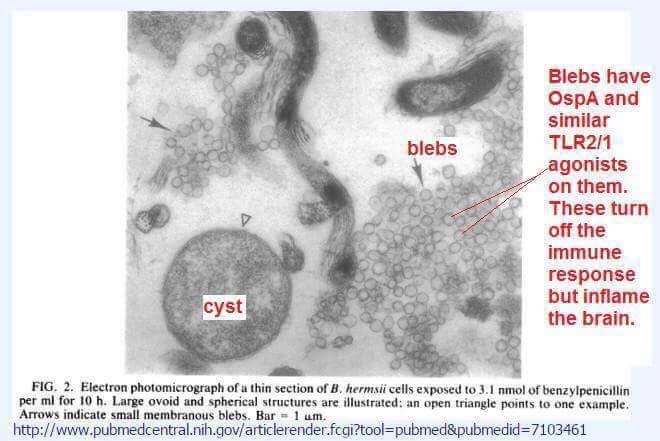
The OspA-laden blebs go to the brain, inflame it, get eaten up by immune cells (which renders them incompetent), they go to the kidneys (LUAT), etc. You will find this to be so in an NIH-owned patent (5,217,872) and elsewhere. This fact has been demonstrated over and over again, by a variety of research groups. See the Occam’s Razor for a more complete list. Here are six that I’ve curated for this piece.
1. THE NIH (Martin and Marques) says Lyme is immunosuppressive but causes brain inflammation. (Martin quit and went home to Germany once he and Marques found, while working for the NIH, that LYMErix or OspAish antigens were responsible for the MS outcome of Lyme):
Borrelia burgdorferi Induces TLR1 and TLR2 in human microglia and peripheral blood monocytes but differentially regulates HLA-class II expression (2006).
“The spirochete Borrelia burgdorferi is the agent of Lyme disease, which causes central nervous system manifestations in up to 20% of patients. We investigated the response of human brain microglial cells, glial progenitors, neurons, astrocytes, as well as peripheral blood monocytes to stimulation with B. burgdorferi. We used oligoarrays to detect changes in the expression of genes important for shaping adaptive and innate immune responses. We found that stimulation with B. burgdorferi lysate increased the expression of Toll-like receptors (TLRs) 1 and 2 in all cell types except neurons. However, despite similarities in global gene profiles of monocytes and microglia, only microglial cells responded to the stimulation with a robust increase in HLA-DR, HLA-DQ, and also coexpressed CD11-c, a dendritic cell marker. In contrast, a large number of HLA-related molecules were repressed at both the RNA and the protein levels in stimulated monocytes, whereas secretion of IL-10 and TNF-alpha was strongly induced. These results show that signaling through TLR1/2 in response to B. burgdorferi can elicit opposite immunoregulatory effects in blood and in brain immune cells, which could play a role in the different susceptibility of these compartments to infection.”
http://www.ncbi.nlm.nih.gov/pubmed/16783164
2. Raymond Dattwyler says stuff like “diminished antibody response” AKA immunosuppression.
Modulation of natural killer cell activity by Borrelia burgdorferi, 1988:
Golightly M, Thomas J, Volkman D, Dattwyler R. Department of Pathology, State University of New York, Stony Brook 11794. PMID: 3056196 [PubMed – indexed for MEDLINE] Ann N Y Acad Sci. 1988;539:103-11.
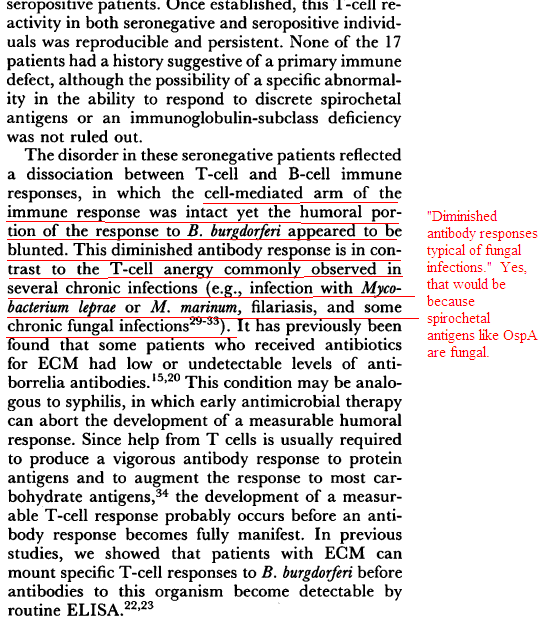
Here is the full text of Dattwyler’s 1988 report, which you may download.
3. Gary Wormser says OspA causes immunosuppression (which means it was the opposite of a “vaccine”):
Modulation of lymphocyte proliferative responses by a canine Lyme disease vaccine of recombinant outer surface protein A (OspA).
“… After exposure to either the unaltered vaccine preparation or OspA prepared in saline, normal lymphocyte responses to the mitogens concanavalin A, phytohemagglutinin-M or pokeweed mitogen, or the antigen BCG were consistently reduced. Whole cell extracts of B. burgdorferi also modulated immune responses but required a much greater quantity of protein than needed for theOspA preparation. The magnitude of modulation was directly dependent on the quantity of OspA. OspA interferes with the response of lymphocytes to proliferative stimuli including a blocking of cell cycle phase progression. Future studies designed to delete the particular region or component of theOspA molecule responsible for this effect may lead to improved vaccine preparations.”
http://www.ncbi.nlm.nih.gov/pubmed/10865170
4. Nicole Baumgarth (UCDavis) says it’s a B cell disease that even affects the victim’s ability to fight viruses.
“For months after infection, those germinal centers fail to produce the specific cells — memory B cells and antibody-producing plasma cells — that are crucial for producing lasting immunity. In effect, the bacteria prevent the animal’s immune system from forming a “memory” of the invading bacteria and launching a protective immune response against future infections.
“The researchers found that following Borrelia burgdorferi infection, this process even prevented induction of strong immune responses to an influenza infection.”
From the UC Davis Website–Lyme and LYMErix cause permanent immunosuppression…or is like a B cell AIDS:
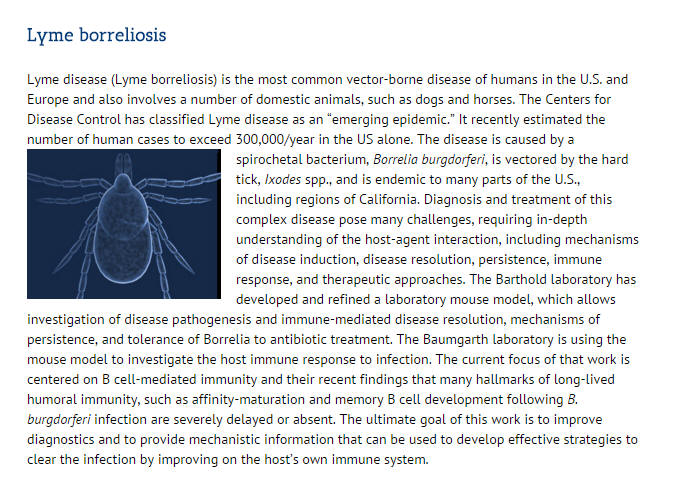
5. Nicole Baumgarth, here, says borrelia screw up lymph node structure within a week:
“We demonstrate that infection with B. burgdorferi results in the loss of the lymph node’s normal tissue architecture within the first week after infection, which is then followed a few days later by the IFNR signaling-dependent accumulation of unusually large numbers of naive B cells at that site. We propose that the induction of apparently aberrant innate signals in lymph nodes represents an evasion strategy of B. burgdorferi designed to disrupt the development of protective immune responses. This may explain the rapid loss of germinal centers in lymph nodes of B. burgdorferi-infected mice (7) and/or the lack of adequate long-term immune protection observed following infection (9, 33).”
http://www.ncbi.nlm.nih.gov/pmc/articles/PMC3993384/
6. UCSF says Lyme and LYMErix-Disease are a disease of immunosuppression, and they say that half the Lyme/tick bite victims remain ill and are not cured with antibiotics.
Feb 12, 2016:
“Early Lyme disease prior to antibiotic therapy was characterized by marked upregulation of Toll-like receptor signaling but lack of activation of the inflammatory T-cell apoptotic and B-cell developmental pathways seen in other acute infectious syndromes,” wrote the study’s authors. “Six months after completion of therapy, Lyme disease patients were found to have 31 to 60% of their pathways in common with three different immune-mediated chronic diseases. No differential gene expression signature was observed between Lyme disease patients with resolved illness to those with persistent symptoms at six months post-treatment.”
So, what is the disease? ILADS thinks they’re treating simple infections but UC Davis and UCSF both say it’s more like permanent immune wreckage and expanding tolerance to virals and true bacteria (TLR4 agonists). It’s EBV-transformed B cells that result in the likes of “autoimmune” diseases like MS, Lupus, etc. With those diagnoses, nobody gives antibiotics for the original infection, and everyone knows they’re long term and more recently are given chemo drugs.
So, when this gunk clogs your newsfeed, ask the question, “What are they treating?”

What are they treating? Will this treatment fix my wrecked lymph nodes or non-functioning B cells?

What are they treating? Will a pretty yellow dress and hot rollers fix it?

What are they treating? A genetic mutation or a B cell mutation?

What are they treating? Persistent spirochetes or an AIDS-like disease?

WTF are they treating?


Nobody is treating the screwed up lymph nodes-transformed B cells-reactivated viruses-post sepsis-AIDS-like disease. Nobody. Because not even ILADS will acknowledge it. The sooner we patients start rejecting these bogus treatments and opportunistic, capitalist miners of desperation profit, the sooner we all will gain access to REAL treatments for the REAL disease, which the NIH, CDC and IDSA all know and understand.
We are all vulnerable. Look out for each other. Don’t share the garbage snake oil ads. Share the truth. Help people get out of the freaking woods, for God’s sake.
XXX
Please watch and share our video: https://vimeo.com/truthcures/crymedisease
<p><a href=”https://vimeo.com/180529812″>LYME CRYME</a> from <a href=”https://vimeo.com/truthcures”>TruthCures</a> on <a href=”https://vimeo.com”>Vimeo</a>.</p>


 badlymeattitude.com
Leave a reply to Jonathan Locke Cancel reply